
Why Do Expensive Data Transformations Start Losing Value Soon After Go-Live?
I have worked on very large enterprise data programs with substantial budgets, extensive vendor ecosystems and dozens of teams, and I have also led the data and analytics agenda inside a lean pharmaceutical organization where every investment had to demonstrate very direct business value, and across both environments I have seen the same structural problem appear repeatedly.
Organizations fund data as a project, even though the data itself behaves like a permanent business capability.
The project gets an executive sponsor, a budget, a delivery team, consultants, milestones and a launch date, after which the implementation is celebrated and the project begins to wind down, while the data sources, customer definitions, market conditions, business requirements and user expectations continue changing almost immediately.
This is one reason the shift toward data products matters, because McKinsey estimates that a well-designed data-product approach can enable new business use cases as much as 90% faster while reducing total cost of ownership by around 30%, largely through reuse, standardization and reduced duplication of pipelines and datasets.
A Familiar Pharma Scenario
Imagine that Brand A requires an HCP segmentation capability, so a team acquires claims data, customer master information and engagement history, develops business rules, creates derived variables, validates the dataset and delivers the segmentation.
Six months later, Brand B needs something similar.
A different project starts, another team extracts overlapping data, slightly different definitions are introduced, another pipeline is created and another set of quality checks emerges.
Medical affairs then requests HCP intelligence for a different purpose, and another variation of essentially the same foundation appears.
None of these teams are necessarily doing anything wrong. The operating model encourages duplication.
I saw this challenge repeatedly when working across Customer 360, decision science, CRM, analytics and data enablement, because each individual initiative can have a valid business case while the enterprise as a whole gradually accumulates several versions of the same customer, product or engagement data.
A data-product mindset changes the question from “What dataset does this project need?” to “What reusable capability should the enterprise operate so multiple use cases can consume it?”
What Makes Something a Data Product?
Calling a dataset a “product” does not make it one, because the term only becomes meaningful when the organization changes the way it owns, funds, measures and improves that capability.
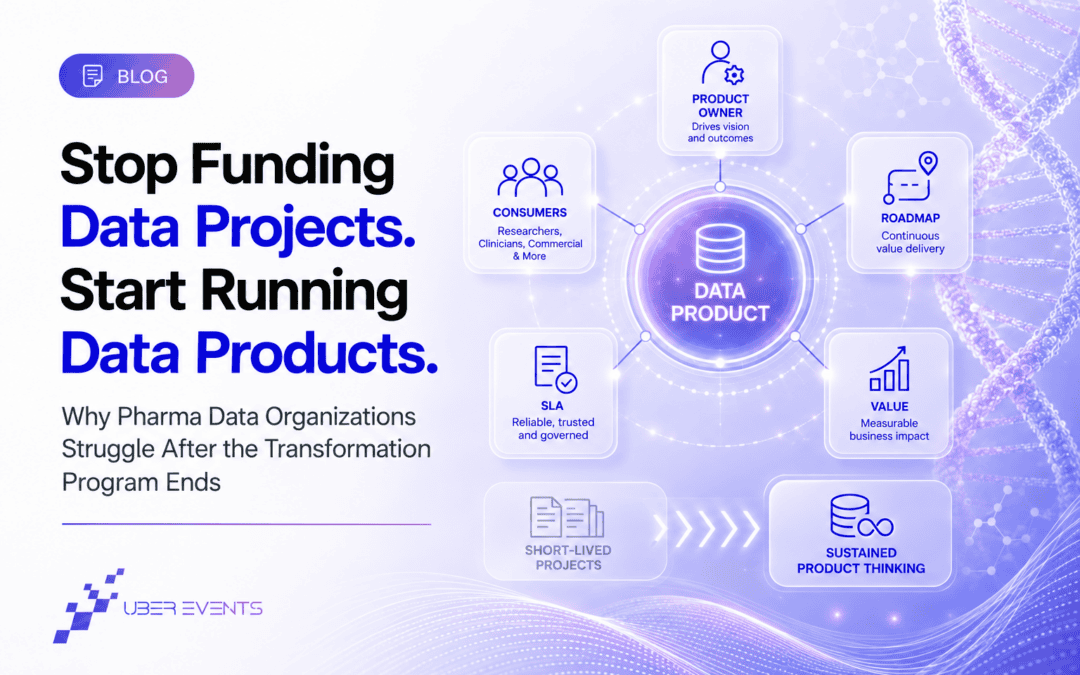
For every strategic data product, I would expect six things to be explicit:
- An accountable owner must exist beyond the initial implementation, with responsibility for quality, roadmap, adoption and business value rather than simply technical availability.
- The consumers must be known, whether they are field teams, marketers, medical colleagues, analysts, data scientists or downstream applications, because product requirements should originate from how people actually use the data.
- A service contract must define what users can rely upon, including refresh frequency, quality thresholds, lineage, key definitions, access rules and how changes will be communicated.
- A roadmap must extend beyond launch, because source systems, business rules and analytical requirements will inevitably evolve.
- Adoption must be measured alongside delivery, since a technically excellent data product that every business team bypasses with its own spreadsheet has not solved the enterprise problem.
- Business value must remain visible, which means connecting the product to faster analytics, reduced duplication, improved targeting, better customer decisions or another measurable outcome.
From a Project to a Product: HCP Intelligence
Consider replacing several brand-specific customer datasets with an enterprise HCP Intelligence Product.
The product could provide governed identity, specialty, affiliations, approved engagement signals, relevant behavioral measures and reusable analytical features, while individual brands or functions could layer their specific logic on top rather than rebuilding the foundation.
This does not mean forcing every business use case into one giant enterprise model.
It means separating what should be shared from what should remain use-case specific.
- Identity should generally be shared.
- Core affiliations should generally be shared.
- Data-quality standards should be shared.
- A brand-specific segmentation score may not need to be shared.
That boundary is where good data-product design becomes both strategic and practical.
What Changes for the CDO Organization?
I believe sustainable CDO-led organizations need a federated model in which the central data organization owns the capabilities that require enterprise consistency while domain teams own the expertise that cannot realistically be centralized.
The CDO organization can establish architecture, common platforms, governance standards, metadata, access patterns, quality frameworks and shared tooling, while customer, clinical, product, commercial or medical domains remain accountable for definitions, priorities, stewardship and business outcomes.
This also changes funding, because an HCP data foundation used by ten business capabilities should not have to search for a new temporary sponsor every time one project ends. Persistent assets require persistent accountability.
The Most Important Question Comes After Go-Live
When I review a data transformation, I therefore ask a question that rarely appears on the project plan:
Who will care about this capability two years from now?
If the answer is unclear, the organization has probably built a deliverable rather than a product.
Data does not stop changing because a project steering committee has closed, and the organizations that create sustainable advantage from data will increasingly be the ones that stop treating their most important data capabilities as temporary transformations and start operating them as products that are continuously owned, measured and improved.
Statistic source: McKinsey & Company, How to Unlock the Full Value of Data—Manage It Like a Product. McKinsey data-product research
Author:
Gunjan Aggarwal is a senior life sciences and healthcare executive with more than 25 years of experience leading data, analytics, digital transformation, and business strategy across global organizations including Novartis, Grünenthal, Averitas Pharma, and Capgemini. Her experience spans pharmaceuticals, oncology, rare diseases, commercial operations, enterprise data strategy, and AI-enabled transformation, with a consistent focus on turning data and technology into measurable business and patient impact.
Having worked across consulting, large global enterprises, and entrepreneurial environments, Gunjan brings a combination of strategic thinking, operational execution, and cross-functional leadership.
LinkedIn: Gunjan Aggarwal
If this area interests you further or are interested to be part of the 2026 Pharma CX Marketing Summit in October, please do get in touch with us.