
If We Have a Golden Record, Why Does the Business Still Disagree About the Customer?
Master data management conversations can become technical very quickly, with discussions about matching algorithms, survivorship rules, identifiers, confidence thresholds and stewardship workflows, but in my experience the business rarely wakes up asking whether the enterprise has improved its golden-record architecture.
The business asks why an HCP appears under two accounts, why sales and marketing have different specialties for the same physician, why a territory changed after a data refresh, or why two leadership dashboards show different numbers.
That distinction is important because the goal of MDM is not to manufacture a perfect golden record; the goal is to create enough trusted consistency that important business decisions do not have to begin with a debate about whose data is correct.
The economic consequence of getting this wrong is not trivial, because Gartner estimates that poor data quality costs organizations at least $12.9 million per year on average, while also identifying inconsistency across sources as one of the most difficult data-quality problems organizations face.
I Have Seen MDM From Both Enterprise and Lean-Pharma Perspectives
At leading pharma company, customer and account data had to support multiple brands, functions, systems and therapeutic areas, while at mid size pharma the environment was considerably leaner but the business requirement was exactly the same: commercial analytics, segmentation, CRM, field execution and leadership reporting all needed to rely on consistent customer, product and account definitions.
Smaller organizations sometimes assume that MDM is primarily a large-enterprise problem, although I would argue the opposite can also be true, because when a lean organization has fewer people available to reconcile data manually, inconsistent master data can consume a disproportionate amount of its analytics capacity.
Consider a relatively ordinary scenario in which an HCP has cardiology as a specialty in one reference source, internal medicine in CRM, activity consistent with another specialty in claims, and two active hospital affiliations maintained by different sources.
Which record is correct?
The uncomfortable answer is that there may not be a universally correct record, because different attributes may require different authoritative sources, effective dates and business rules.
That is where MDM moves from technology into governance.
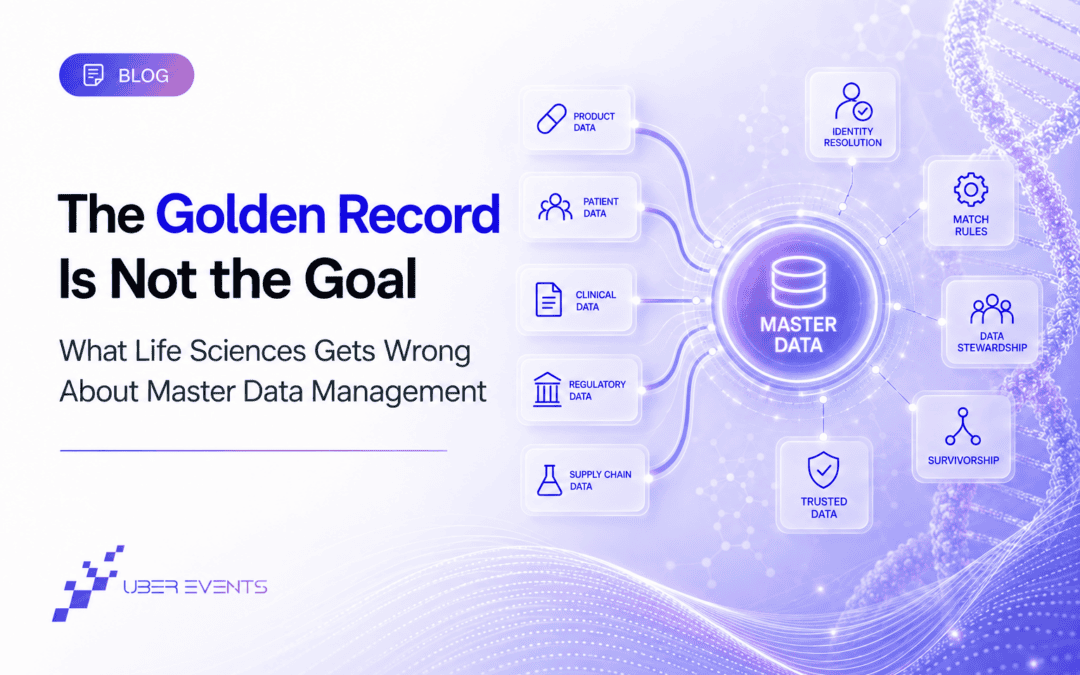
The Five Decisions Every MDM Program Has to Make
I use a relatively simple framework when thinking through customer, account or product master data:
- DEFINE
The organization first needs to agree on what the entity means in the context of the business, because an “account” may represent a legal entity for finance, an integrated delivery network for strategy, a physical facility for field alignment or a buying organization for contracting, and forcing all four meanings into one definition usually creates more confusion rather than less.
- MATCH
The next question is how records from different systems are determined to represent the same real-world entity, including which identifiers, names, addresses, affiliations and other characteristics are used, and how much uncertainty the organization is willing to tolerate before sending an exception for review.
- SURVIVE
When sources disagree, the organization needs explicit survivorship rules describing which value wins under which circumstances, because simply declaring one entire source “authoritative” is often insufficient when another source may be stronger for a particular attribute.
- STEWARD
Some ambiguity will always remain, which means the organization needs a clear process for resolving high-value exceptions, including who owns the decision, how quickly it must be resolved and whether the underlying source process also needs correction.
- MEASURE
Finally, quality has to be measured in terms of business consequences, because a master dataset that is technically 98% complete could still create significant operational problems if the remaining exceptions involve the highest-priority accounts or customers.
A Practical Use Case: Affiliation Data
Affiliation is one of the easiest places to see why these decisions matter.
Suppose a high-priority HCP appears associated with Hospital A according to one third-party source, Hospital B in CRM and a larger health system in the account hierarchy, while field knowledge suggests that the physician divides time between both locations.
- A simplistic golden-record approach forces one answer.
- A mature MDM approach asks what the business is trying to do.
- If the purpose is territory assignment, the organization may need a primary practicing location.
- If the purpose is account planning, multiple affiliations may be relevant.
- If the purpose is analytics, effective dates and affiliation strength may matter.
- If the purpose is digital activation, a different set of attributes could become important.
The master record should serve the decision rather than forcing every decision to serve the master record.
MDM Is an Operating Discipline, Not a Cleanup Project
One of the biggest mistakes I see is treating MDM as a project that reaches completion after matching rules are implemented and historical records are cleansed, because customer identities change, physicians move, organizations merge, products evolve and new data sources continuously introduce competing information.
The sustainable model therefore requires persistent ownership, measurable data-quality service levels, exception workflows, source accountability and a regular mechanism for changing business rules when the organization itself changes.
The central data team can provide technology, standards and monitoring, but business owners must remain accountable for definitions and the consequences of those definitions.
The question I would ask leadership is therefore not, “Do we have a golden record?”
I would ask, “When two important systems disagree tomorrow morning, do we already know how the business will decide which answer to trust?”
If the organization cannot answer that question, the MDM work is not finished, regardless of how sophisticated the matching technology may be.
Statistic source: Gartner, Data Quality: Why It Matters and How to Achieve It. Gartner data-quality research
Author:
Gunjan Aggarwal is a senior life sciences and healthcare executive with more than 25 years of experience leading data, analytics, digital transformation, and business strategy across global organizations including Novartis, Grünenthal, Averitas Pharma, and Capgemini. Her experience spans pharmaceuticals, oncology, rare diseases, commercial operations, enterprise data strategy, and AI-enabled transformation, with a consistent focus on turning data and technology into measurable business and patient impact.
Having worked across consulting, large global enterprises, and entrepreneurial environments, Gunjan brings a combination of strategic thinking, operational execution, and cross-functional leadership.
LinkedIn: Gunjan Aggarwal
If this area interests you further or are interested to be part of the 2026 Pharma CX Marketing Summit in October, please do get in touch with us.